Fraud

How to identify and prevent the most prevalent cyber scam

Cybercrime: Social engineering fraud

Protecting your business against social engineering fraud

Social engineering fraud (SEF) accounts for 98% of all cyberattacks.Disclosure 1 In their attempts to steal company funds, scammers manipulate individuals using tactics such as text messaging (smishing) and email phishing. According to the FBI, just one category of social engineering fraud—business email compromise—resulted in nearly $55.5 billion in losses between October 2013 and December 2023.Disclosure 2

Key concepts

In this article, we’ll talk about how to:

  • Understand the threat
  • Recognize common tactics
  • Know the potential targets
  • Set up strong defenses

Social engineering: A quick introduction

Component ID : "accordionGridLayout-644423604"
Model : "disclaimer"
Position : "left"

[Fraud prevention 101: Social engineering] [Truist logo]

[Social engineering: This scheme is behind most fraudulent attempts.]

Social engineering: /ꞋsōSHƏl enjƏꞋni(Ə)riNG/ noun (in the context of information security) the use of deception to manipulate individuals into divulging confidential or personal information that may be used for fraudulent purposes.

Narrator: Social engineering—or psychological manipulation—is the basis for nearly every attempted cyberattack. Cybercriminals can try to trick you into providing private information by offering fraudulent promotions or IT help over the phone or email. Verify any source that requests information from you, and never give out personal, financial, or company details unless you’re already familiar with the person on the receiving end.

[Learn more tips for staying vigilant.]

Truist [logo]

Contact your Truist relationship manager or treasury consultant for more information on fraud protection.

Truist Bank, Member FDIC. © 2024 Truist Financial Corporation.

Truist, the Truist logo and Truist Purple are service marks of Truist Financial Corporation.

[end transcript]

How does social engineering fraud happen?

Social engineering fraud originates with scammers harvesting personal data about your employees, vendors, or customers. Then, they use these details to create a convincing impersonation of an individual your employees trust—with the aim of tricking your team into disclosing sensitive information or clicking on malicious links.

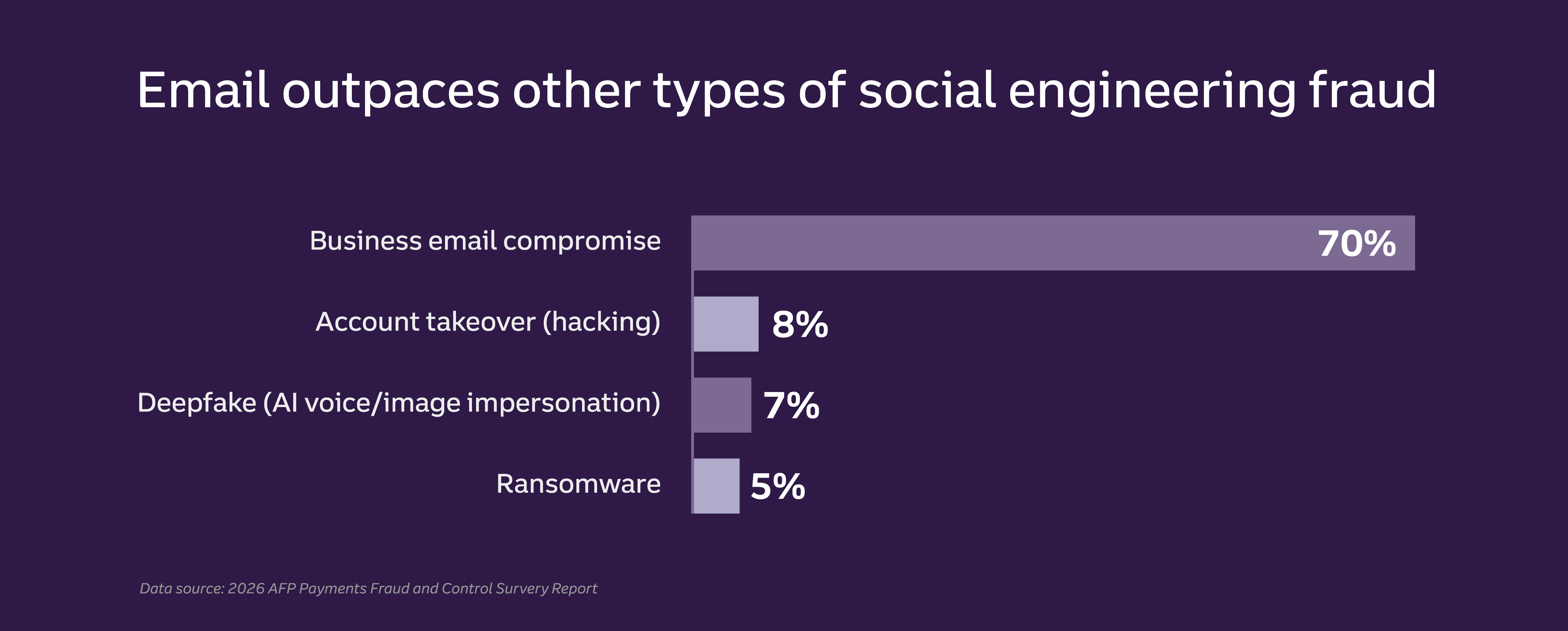
Social engineering fraud is not a single tactic; it is a broad strategy that encompasses a range of techniques, including phishing and account takeovers. The 2026 AFP Payments Fraud and Control Survey Report, underwritten by Truist, shows that scammers use a wide array of SEF tactics. Business email compromise (BEC) is the most prevalent, accounting for 70% of all SEF incidents—whether attempted or completed.Disclosure 3

$4.4 million:

The average cost of a social engineering-related breach across U.S. industriesDisclosure 4

Who does it affect?

Everyone in your organization can be a target of SEF. This type of attack can be directed at one or two key players or a whole team.

Good news: Cybersecurity awareness training really works.

Three months of cybersecurity training has been shown to reduce the risk of social engineering attacks like phishing by over 40%—with susceptibility dropping from 86% down to just 4.1% after a year of employee training.Disclosure 5

Bar graph titled, “Email outpaces other forms of attacks.” Bar graph labels are as follows: Business email compromise, 70%; Account takeover (hacking), 8%; Deepfake (AI voice/image impersonation), 7%; Ransomware, 5%. Data source: 2026 AFP Payments Fraud and Control Survey Report.

How to respond

If personal information is stolen in a SEF attack, quickly address the data breach and disclose to partners what you’re doing to mitigate their financial and reputational damage and to improve safeguards around their information.Disclosure 6 Also, let them know how they can help you keep their information safe.

Customers appreciate proactive, transparent communications about data breaches.

Best practices and prevention

Preventing losses from social engineering fraud starts with you—and the processes you put in place to protect your company. Here are several strategies that can help your employees spot and avoid social engineering scams.

Implement a workplace education program.

Train your team to recognize and report suspicious messages, attachments, and links. Create protocols for identifying red flags, reinforce these trainings regularly, and implement programs for new hires.

Run attack simulations on your team.

Regularly expose staff to the latest social engineering scam methods and malware in a safe way through mock attacks performed by your IT team. They can trace who fell for tactics like spear phishing or vishing and, crucially, highlight areas where you may need more training and protection.

Investigate and upgrade your tech protection.

Technology like multifactor authentication (MFA) boosts your ability to screen out scams distributed by bots. Tech tools like behavioral biometrics can also help you and your team spot the difference between fraudsters and genuine users.

Go directly to the source.

Are you in doubt about the authenticity of any company communications you’ve received? Reach out to the company directly to verify the origin of any suspicious emails, voicemails, or texts. For example, if the communication claims to be from Truist, you can ask your relationship manager to confirm it’s legitimate before taking any action.

Update your cyber insurance coverage.

If prevention fails and your company is attacked, a social engineering fraud insurance policy can help minimize your losses. Talk to your agent to learn what’s available and what makes the most sense for your business.

FAQs on social engineering fraud

Component ID : "faq-1301646222"
Model : "faq"
Position : "left"

Pretexting occurs when scammers use a false narrative to gain a victim’s trust and manipulate them into sharing sensitive personal information, downloading ransomware, or engaging in acts that defraud your company. Scammers often pose as a company executive, vendor, partner, employee, or member of a regulatory body and then infuse their pretext with a sense of urgency that intimidates the target into compliance.

Ransomware is a form of malicious software, or malware, that, when installed on your system, locks up your computer network until a sum of money is paid.

Multifactor authentication is a multistep sign-in process often used to access sensitive information like company networks and bank accounts. To start, MFA users usually enter sensitive information like a password or use biometrics like face or voice recognition. This triggers the MFA system to send a confirmation message via an authenticator app, text, or email. Having more than one virtual door to unlock makes it harder for a hacker to gain access.

Turn to professionals for protection.

To learn more about cybersecurity threats and the various types of fraud facing your organization, talk to your Truist relationship manager. Or start a relationship with us if you’re new to Truist.

Truist Purple Paper® Developing a treasury ecosystem to propel your business

Learn how a new era of payments technology can transform the way you succeed.

Related resources

How To Defend Against Business Email Compromise

How To Defend Against Business Email Compromise

Fraud How to detect and defend against business email compromise

Article
07/22/2025
How To Defend Against Business Email Compromise

Business email compromise happens when scammers impersonate someone you trust in an attempt to defraud your company. Learn how to spot and prevent BEC.

How to defend your business against password theft

How to defend your business against password theft

Fraud How to defend your business against password theft

Password theft is a foundational cybercrime hackers rely on to access your company’s computer networks. Learn how to spot and stop these attacks.

Article
09/12/2024
How to defend your business against password theft

Password theft is a foundational cybercrime hackers rely on to access your company’s computer networks. Learn how to spot and stop these attacks.

How to protect against wire transfer fraud

How to protect against wire transfer fraud

Fraud How to stop wire transfer fraud

Learn tips and tactics for preventing wire transfer fraud.

Article
07/16/2025
How to protect against wire transfer fraud

Learn what makes wire transfer fraud one of today’s biggest cybersecurity threats and get tips for preventing it.

    {0}
    {6}
    {7}
    {8}
    {9}
    {12}
    {10}
    {11}

    {3}

    {1}
    {2}
    {7}
    {8}
    {9}
    {10}
    {11}
    {14}
    {12}
    {13}

    Stay informed and get connected

    Looking for fresh thinking and new insights to help uncover opportunities for your business needs?

    Connect with a Relationship Manager

    Work with a partner who sees your vision and has the resources to help you achieve it. We’re ready to focus on the specific needs of your company—and where you are in your business lifecycle.

    *This form is for prospects. Truist clients should contact their relationship manager with inquiries related to commercial products and services.

    Helpful links


    Sign up for monthly articles on Business Insights

    Sign up to receive our business insights, thought leadership, and client success stories that can help inspire your next bold business move.

    Please enter a first name
    Please enter a last name
    Please enter a valid email address
    Please enter a company name
    I'm also interested in: Please select a campaign option